
Back to Extensions
CiteSnap
Developer Tools

CiteSnap

Can ChatGPT actually cite this page?
0+ users
Verified

About

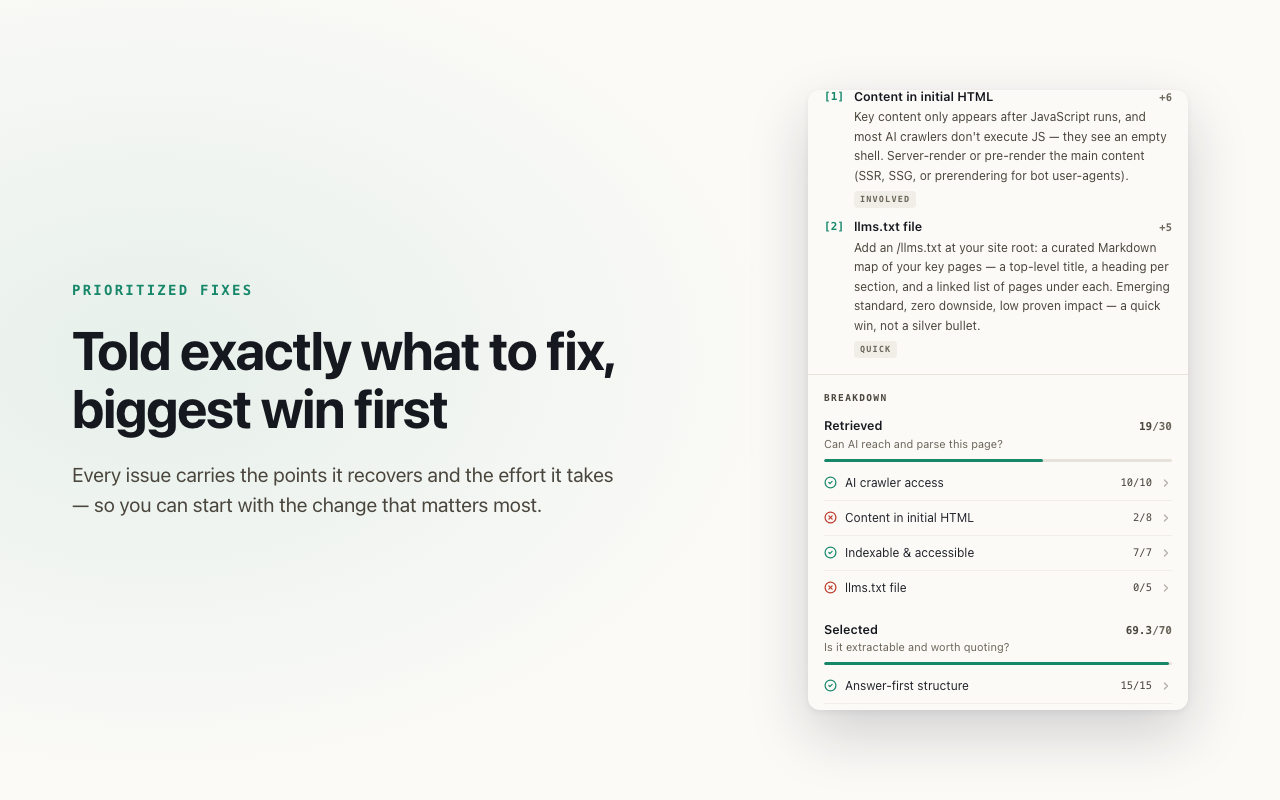
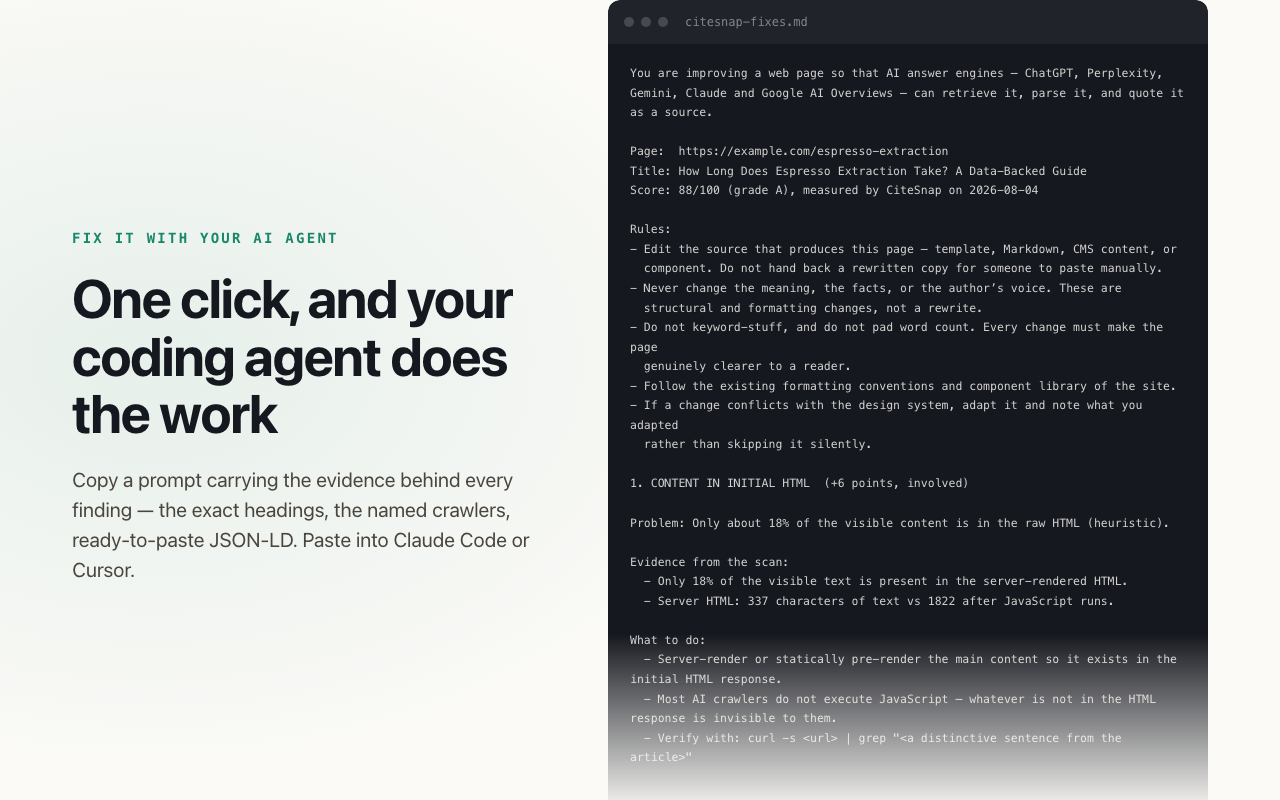
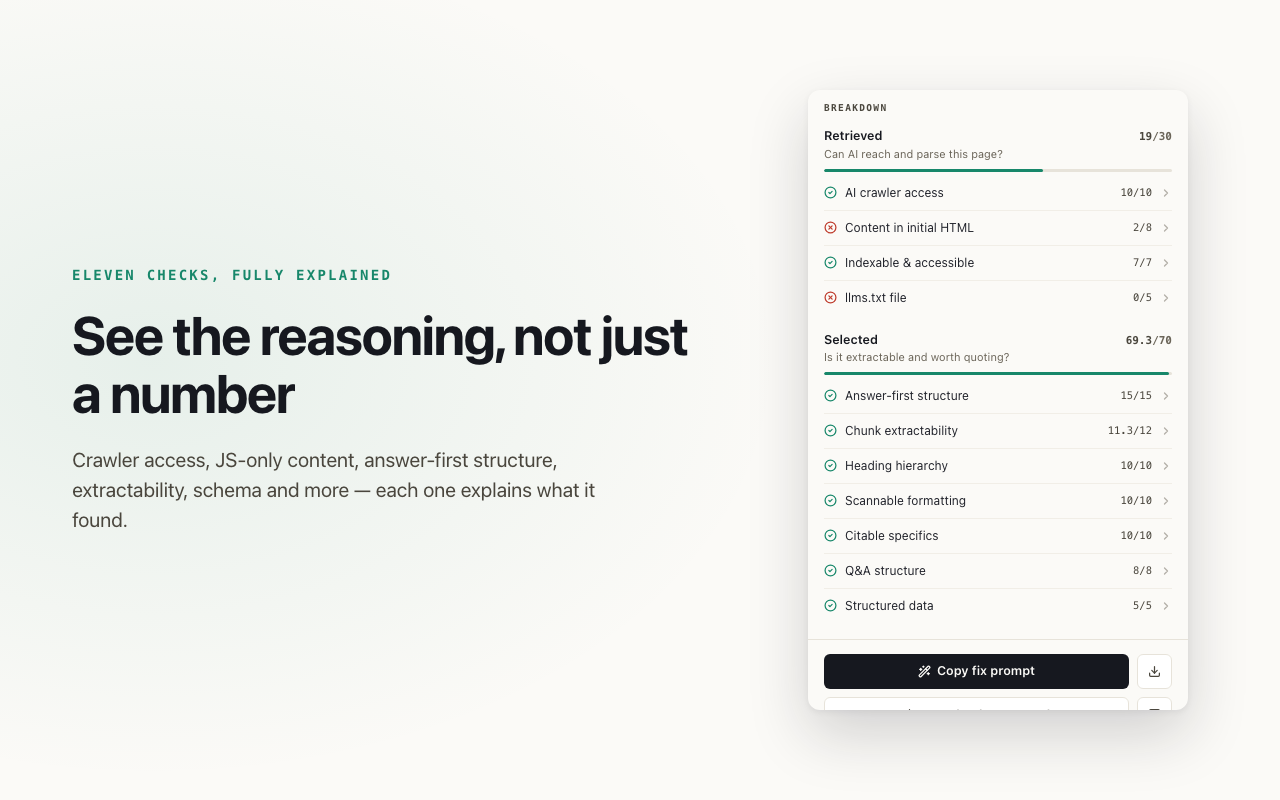
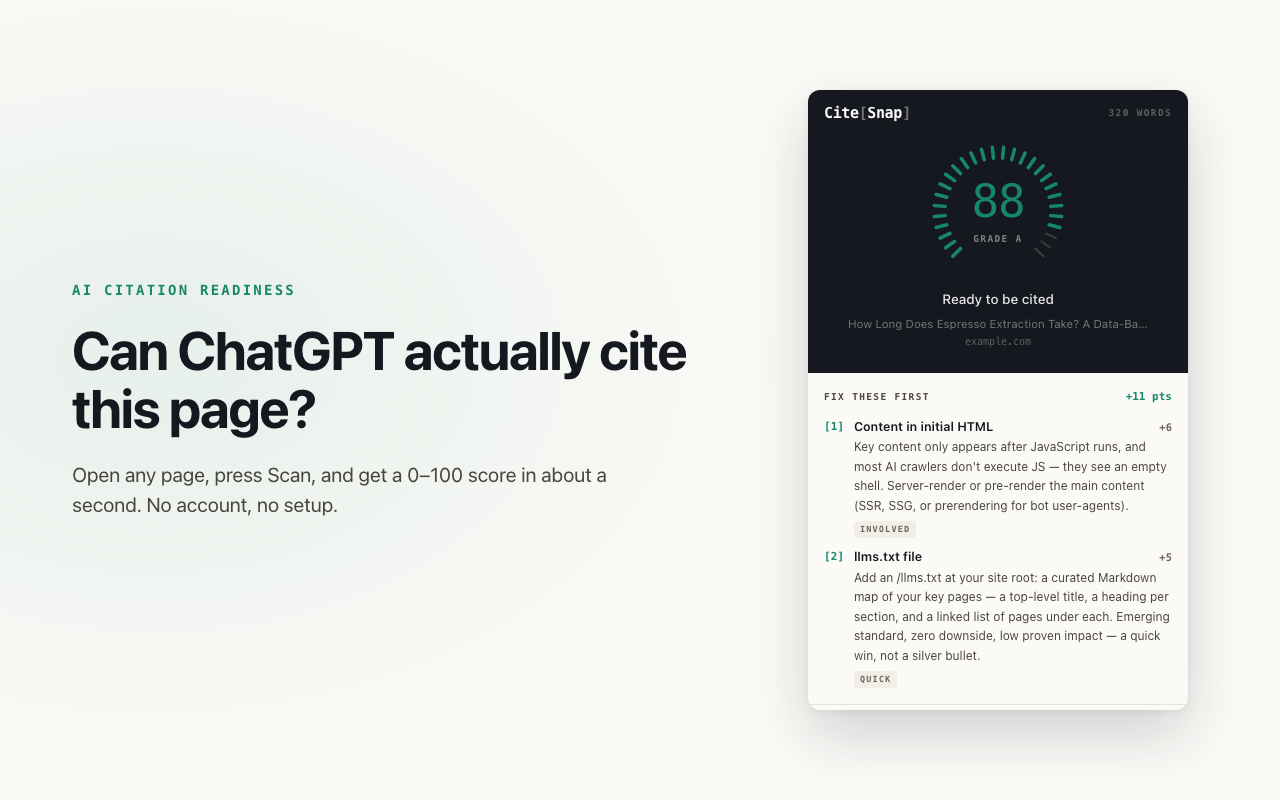
CiteSnap tells you whether AI answer engines can actually find the page you're looking at, read it, and quote it. Click the icon, press Scan, and in about a second you get a 0–100 citation-readiness score, a letter grade, the blockers that make a page uncitable no matter how good the writing is, and a ranked fix list with the points each fix recovers and the effort it takes. Eleven checks run across two groups: Retrieved (30 points) covers AI crawler access in robots.txt for GPTBot, ClaudeBot, PerplexityBot, Google-Extended, OAI-SearchBot and 7 more, whether content exists in the initial HTML before JavaScript runs, indexability, and llms.txt. Selected for synthesis (70 points) covers answer-first structure, chunk extractability, heading hierarchy, scannable formatting, citable specifics, Q&A structure and JSON-LD. Most of the weight sits on extractability, because that's what actually decides whether a passage gets quoted. Press "Copy fix prompt" and CiteSnap writes a complete brief for Claude Code, Cursor or any coding agent — carrying the evidence behind every verdict plus copy-pasteable JSON-LD and robots.txt snippets, ordered blockers-first. Nothing is collected, stored or transmitted: there is no account, no backend, and nothing runs on any page until you click Scan.

Screenshots
CiteSnap screenshot 1CiteSnap screenshot 2CiteSnap screenshot 3CiteSnap screenshot 4CiteSnap screenshot 5

Key Features

  • 0–100 citation-readiness score and letter grade for any page, in about a second
  • Blockers surfaced first — the issues that make a page uncitable no matter how well it's written
  • Ranked fix list, biggest win first, each with the points it recovers and the effort it takes
  • AI crawler check: whether robots.txt lets GPTBot, ClaudeBot, PerplexityBot, Google-Extended, OAI-SearchBot and 7 more fetch the URL
  • Content-in-initial-HTML check — most AI crawlers don't execute JavaScript
  • Extractability checks: answer-first structure, self-contained chunks, heading hierarchy, scannable formatting
  • Citable-specifics density, Q&A structure and JSON-LD validation
  • "Copy fix prompt" writes a full brief for Claude Code, Cursor or any coding agent, with the evidence behind every verdict
  • Shareable score card exported as an image
  • Only two permissions — activeTab and scripting, no host access, no install warning
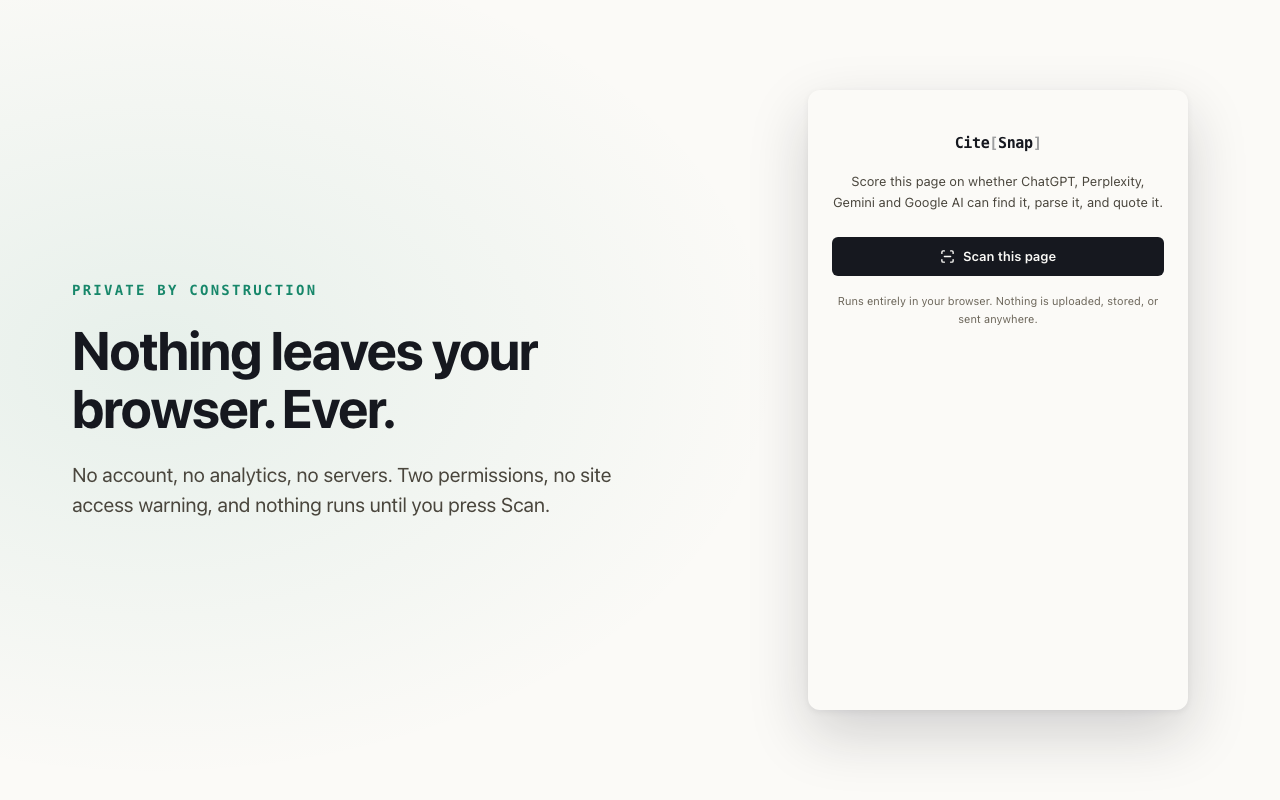
  • No account, no servers, no analytics, nothing stored anywhere

Permissions

Active Tab
Grants temporary access to the single tab you are on, only when you click the extension icon. Used to read the page's rendered DOM and to fetch that same site's /robots.txt, /llms.txt and HTML — the inputs the citation-readiness checks require. Access begins on your click and ends with the tab. Because CiteSnap requests no host permissions, Chrome shows no "read your data on all websites" warning at install.
Scripting
Required to inject the analysis script with chrome.scripting.executeScript when you press Scan, so the page can be read after the site's own JavaScript has rendered it. The script is bundled in the extension, contains no remote code, does not modify the page, and there are no static content scripts — nothing runs on any page otherwise.

What's New

v0.1.0Aug 2026
Initial release. Eleven citation-readiness checks across Retrieved (30 pts) and Selected for synthesis (70 pts), prioritized fix list with points and effort, agent-ready fix prompt export, and shareable score card. Fully local — activeTab + scripting only, no host permissions, no data collection.

Data Privacy

Data Collected

  • Page content (read in memory only)
    When you press Scan, the analysis script reads the current page's rendered DOM to compute the score. The content is scored in memory, the result is passed to the popup, and everything is discarded when the popup closes. Nothing is stored and nothing leaves your device.
  • Current page URL (read in memory only)
    The URL of the tab you are scanning is used locally to request that same site's /robots.txt, /llms.txt and HTML. It is never stored, logged or transmitted anywhere else.

Not Collected

  • Personal information, accounts, emails or identifiers — there is no sign-up and no way to create one
  • Analytics, telemetry, crash reporting or usage statistics
  • Browsing history, or any activity on tabs other than the one you scan
  • Cookies, localStorage, IndexedDB or chrome.storage — no storage permission is declared
Read Full Privacy Policy

Frequently Asked Questions

Two things, weighted. Retrieved (30 points) asks whether an AI can reach and parse the page at all: AI crawler access in robots.txt, whether the content exists in the initial HTML before JavaScript runs, indexability, and llms.txt. Selected for synthesis (70 points) asks whether the content is extractable and worth quoting: answer-first structure, self-contained chunks, heading hierarchy, scannable formatting, citable specifics, Q&A structure and structured data.
No. There is no server to send it to. The scanner is injected only when you click Scan, reads the page, computes the score in your browser, and the result is discarded when the popup closes. The only network requests go to the site you are already on, for its own robots.txt, llms.txt and HTML.
CiteSnap requests activeTab and scripting, and no host permissions at all. activeTab grants temporary access to one tab in response to your click, which is why Chrome shows no "read your data on all websites" warning when you install it. Nothing runs on any page until you press Scan.
It writes a complete brief you can paste into Claude Code, Cursor or any coding agent with access to your site. The prompt carries the evidence behind every verdict — the exact headings that bury their answer, the crawlers named in your robots.txt, your measured specifics density — plus copy-pasteable JSON-LD and robots.txt snippets, ordered blockers-first, with instructions not to change your meaning or keyword-stuff.
No, and no tool can. The answer engines do not publish their ranking criteria. CiteSnap scores what is observable and well-evidenced: whether crawlers can reach you, whether the content survives extraction, and whether it is structured the way answer engines demonstrably prefer to quote. Where a signal is unproven it says so — the llms.txt check tells you outright that it is a quick win with low proven impact rather than pretending it is a ranking factor.
ChromeAdd to Chrome
Version0.1.0
UpdatedAug 2026
Size0.4 MB
DeveloperMIE